
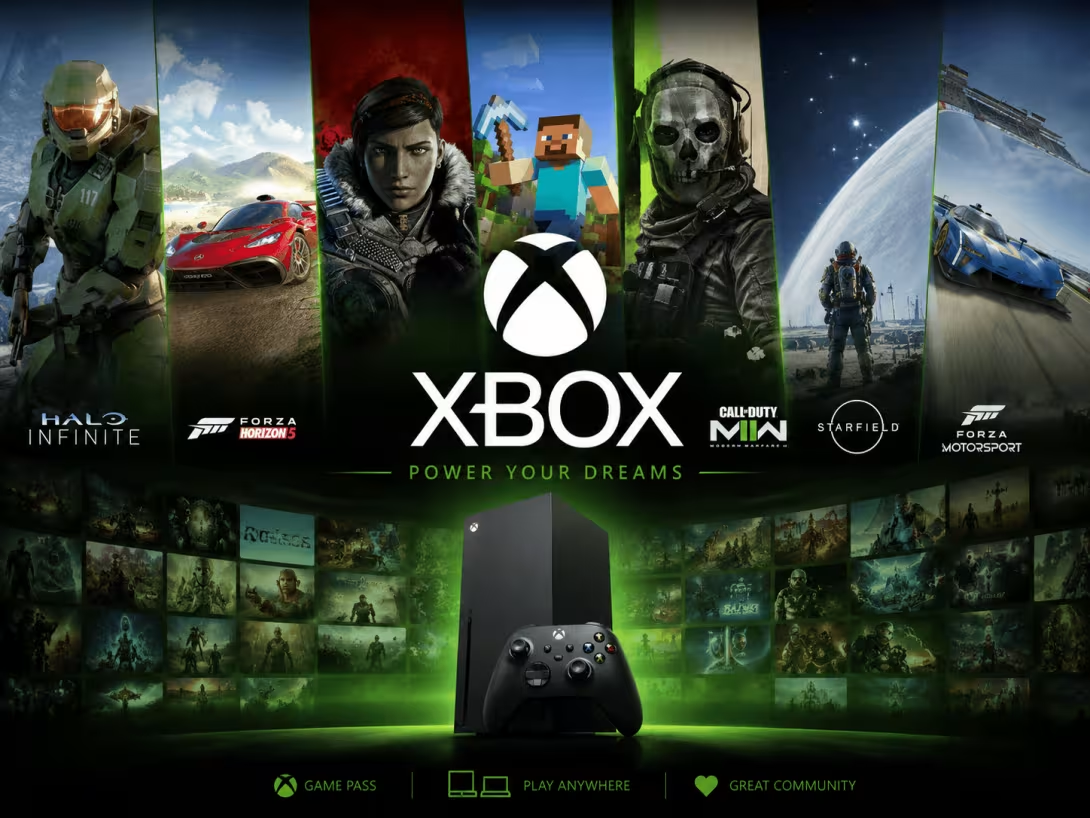
Microsoft’s Xbox division is facing one of its most consequential strategic reviews in years, with leadership reportedly considering a spinoff, subsidiary structure or joint venture as financial pressure intensifies. Internal metrics cited in the source material show Xbox’s accountability margin has fallen to just 3%, while heavy investment has failed to reverse revenue erosion outside Activision Blizzard King. New Xbox CEO Asha Sharma is pushing a sharper reset, including possible exclusivity changes, hardware partnerships, layoffs and marketing cuts. For investors, the issue is no longer whether Xbox has cultural value, but whether it can produce durable financial returns.
Microsoft Weighs A Structural Reset For Xbox
Microsoft is reportedly evaluating several strategic options for its Xbox gaming business, including a possible spinoff, a reorganization into a wholly owned subsidiary or even a joint venture with outside partners. According to The Information, which cited three people with direct knowledge of the discussions, the review is part of a broader effort to address persistent financial underperformance inside one of Microsoft’s most recognizable consumer divisions.
No restructuring decision is imminent, and the company is said to be keeping multiple options open. Still, the fact that such alternatives are being discussed marks a significant moment for Xbox, a business that has long served as Microsoft’s gateway into living rooms, gaming communities and interactive entertainment.
The most consequential possibility would be a spinoff. Such a move could give Xbox greater operational flexibility, a clearer financial identity and potentially a valuation framework separate from Microsoft’s enterprise software and cloud businesses. A subsidiary structure, by contrast, would allow Microsoft to preserve ownership while increasing accountability. A joint venture could bring in partners to share hardware costs, content investment and distribution risk.
A Gaming Division Under Financial Pressure
The reported discussions come amid rising internal concern over Xbox’s financial trajectory. On Tuesday, new Xbox CEO Asha Sharma circulated an internal memo titled “The Next 100 Days: Xbox Reset”, marking her 100th day in the job and offering a blunt assessment of the division’s economics.
According to the memo cited in the source material, Xbox’s “accountability margin” has fallen to just 3%. That figure, described as Microsoft’s internal profit metric, suggests the gaming business is operating with little room for error despite years of investment, acquisitions and platform expansion.
Sharma’s message was especially striking because it separated Xbox’s legacy operations from the impact of Activision Blizzard King. She wrote that, excluding Activision Blizzard King, Microsoft had spent more than $20 billion over the past five years on content, platform development and hardware subsidies, while annual revenue declined by nearly $500 million over the same period.
Her conclusion was direct: “Going forward, this cannot continue.”
The Core Problem: Heavy Investment, Weak Returns
Xbox’s challenge is not a lack of ambition. The division has invested aggressively in gaming content, subscription services, cloud gaming, console hardware and studio acquisitions. The problem is that the financial payoff has not matched the scale of spending.
In practical terms, Microsoft appears to be confronting a difficult question: Can Xbox remain a broad, capital-intensive gaming ecosystem while delivering returns that justify continued corporate support?
The pressure is sharper because Microsoft’s broader business is defined by high-margin engines such as cloud infrastructure, productivity software, enterprise subscriptions and artificial intelligence services. Against that backdrop, a gaming division producing a 3% internal margin looks financially thin, even if the brand remains culturally powerful.
Layoffs And Marketing Cuts Signal A Broader Reset
The financial review is not taking place in isolation. Bloomberg reported that Xbox is preparing major layoffs shortly after Microsoft closes its fiscal year on June 30, alongside reductions in marketing budgets. Reuters also confirmed the planned job cuts, according to the provided source material.
For investors, layoffs are rarely the whole story. They can improve near-term cost discipline, but they do not by themselves solve strategic weakness. The larger issue is whether Microsoft can reshape Xbox into a business with healthier unit economics, more predictable cash flows and a sharper competitive position.
Cost cuts may stabilize margins, but they cannot replace a credible growth model. That is why the discussion around a spinoff, subsidiary or joint venture matters. It suggests Microsoft may be considering whether Xbox needs a fundamentally different corporate architecture rather than another round of operational tightening.
Game Releases Continue Despite Corporate Uncertainty
Even as Xbox’s ownership and structure are reportedly being reviewed, the division continues to push forward with its content pipeline. At the Xbox Games Showcase on June 6, Microsoft confirmed Halo: Campaign Evolved for a July 28 launch and revealed Gears of War: E-Day for October.
A Fallout 3 remaster is also said to remain in active development, though no release date has been announced.
This pipeline is important because content remains the lifeblood of the gaming business. Strong releases can support console engagement, subscription retention, software sales and brand loyalty. However, the financial question is whether even successful titles can offset rising development costs, hardware pressures and strategic fragmentation.
A Shift Away From Multiplatform Expansion
One of Sharma’s more notable moves has been a partial reversal of Xbox’s recent multiplatform strategy. She reportedly announced that Gears of War: E-Day and Clockwork Revolution will remain exclusive to Xbox.
That decision surprised many employees and reportedly strained relationships with Sony. Strategically, it signals a renewed emphasis on platform differentiation. Exclusives can help preserve the value of Xbox hardware and services, but they also limit the revenue potential that comes from selling games across rival platforms.
This is the classic gaming trade-off: exclusivity strengthens ecosystems, while multiplatform distribution expands addressable revenue. Microsoft now appears to be reassessing where the balance should sit.
New Leadership, Old Strategic Questions
Sharma took over in February after Phil Spencer retired following 38 years at Microsoft. Her mandate, as described in the source material, is to make Xbox “the number one gaming and entertainment company” rather than simply push the division toward enterprise-level margins.
That distinction matters. Microsoft may not expect Xbox to resemble Azure or Office financially. Gaming is a different business, with different cycles, risks and capital demands. But even if Xbox is judged by gaming-sector standards rather than enterprise-software standards, the reported numbers point to a division under pressure.
Industry analysts have long debated whether Xbox would be better positioned outside Microsoft. In February, Rhys Elliott of Alinea Analytics described a spinoff as “the most rational long-term strategy.” That view now appears more relevant as Xbox faces rising costs and unclear profitability.
The Hardware Problem Is Getting Harder
Perhaps the most serious long-term issue is hardware. Sharma reportedly warned that component costs for Xbox’s next-generation console could quintuple by the 2027 holiday season. If accurate, that would put enormous pressure on Microsoft’s traditional console economics.
Gaming hardware has often relied on subsidies, with companies accepting low or negative margins on devices to make money later through software, subscriptions and ecosystem spending. But if hardware costs rise dramatically, that model becomes harder to defend.
Sharma’s conclusion was clear: Xbox needs a new business model and hardware partnerships. That could mean co-developed devices, licensing arrangements, cloud-first hardware, third-party manufacturing partnerships or a reduced reliance on traditional console cycles.
What A Spinoff Could Mean For Microsoft
A spinoff would be a bold move, but not an irrational one. It could allow Microsoft to separate a lower-margin, consumer-facing, content-heavy business from its higher-margin software and cloud operations. It could also make Xbox easier to value, easier to restructure and potentially easier to partner with.
For Microsoft shareholders, the logic would be straightforward: If Xbox cannot meet internal return thresholds, separating it could reduce complexity and improve capital allocation. Microsoft would still have the option to maintain commercial ties through cloud services, AI tools, distribution agreements or minority ownership.
However, a spinoff would also carry risks. Xbox remains strategically connected to Microsoft’s consumer ecosystem, cloud ambitions and broader entertainment strategy. Separating it too aggressively could weaken Microsoft’s position in gaming just as interactive entertainment becomes increasingly tied to AI, streaming, advertising and digital communities.
Investor Takeaways
For investor-minded readers, the Xbox situation should be viewed as a capital allocation story rather than a simple gaming headline. The division has brand power, valuable franchises and a global audience. But the reported figures suggest that brand strength has not translated into adequate financial performance.
The key question is whether Microsoft can turn Xbox from a strategically important asset into a financially disciplined one. If management succeeds, Xbox could remain a meaningful pillar in Microsoft’s consumer and entertainment portfolio. If it fails, a spinoff, joint venture or deeper restructuring could become increasingly likely.
The next signals to watch are clear: the scale of post-June 30 layoffs, changes to marketing spending, updates to the exclusivity strategy, new hardware partnership announcements and any formal move to reorganize Xbox’s corporate structure.
Bottomline: Xbox Faces Its Most Important Reset In Years
Xbox is not disappearing, but it may be approaching a structural turning point. The reported internal margin pressure, heavy investment burden, declining revenue outside Activision Blizzard King and looming hardware cost inflation all point to a business model that needs repair.
Sharma’s early tenure appears defined by urgency. Her message to employees was not simply that Xbox must cut costs. It was that the division must rethink how it makes money, how it invests, how it builds hardware and how it competes.
For Microsoft, the decision is strategic as much as financial. Xbox gives the company relevance in gaming culture and entertainment, but relevance alone does not satisfy shareholders. The coming months may determine whether Xbox remains a fully integrated Microsoft division, becomes a more independent subsidiary, enters a partnership model or eventually moves toward a spinoff.
- Log in to post comments